
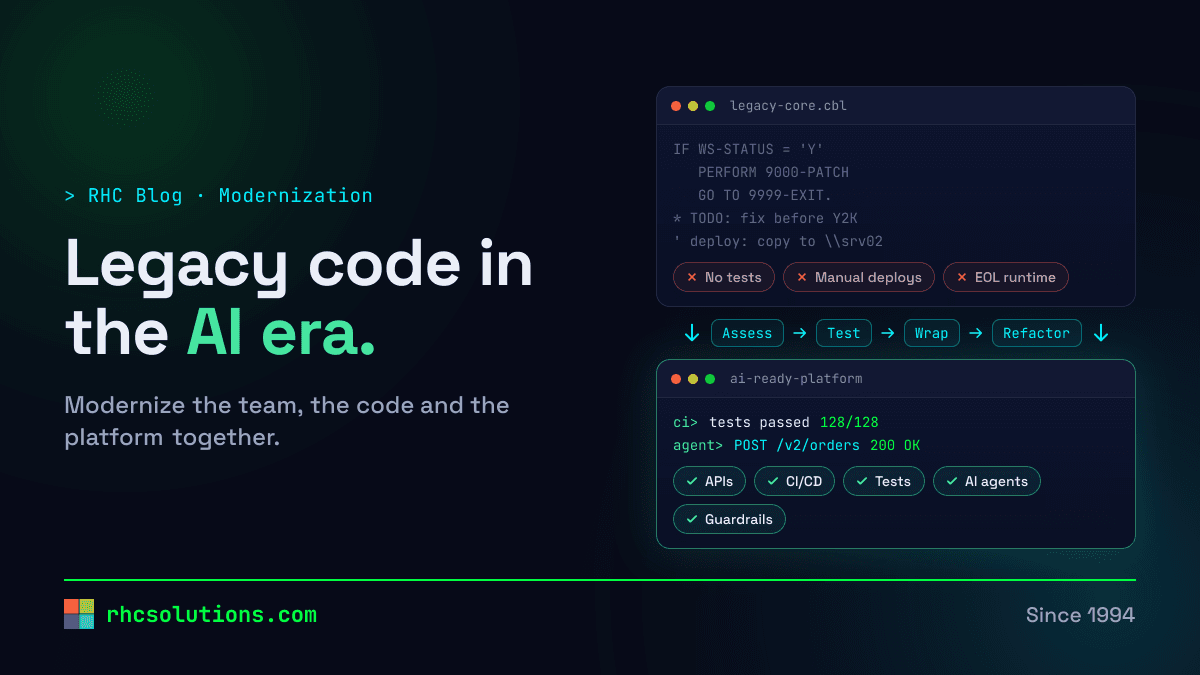
Modernize the team, the code and the platform together
Legacy Code in the AI Era: Why Your Dev Team and Stack Must Modernize Now
Legacy code modernization is no longer optional. AI coding assistants, cloud platforms and AI agents all assume software that is tested, documented, reachable through APIs and shipped through automated pipelines. Bolt AI onto teams and systems built for a slower era and it amplifies their weak spots instead of fixing them. The answer is a staged program, not a big-bang rewrite: upskill the developers you already have, wrap and refactor the systems that run the business, and put guardrails around AI from day one.
In short: AI does not fix an engineering organization; it amplifies whatever is already there. Teams with tests, small releases and clean interfaces get faster. Teams with untested monoliths, manual deployments and knowledge locked in a few people’s heads get more incidents, more risk and more code nobody understands. Modernizing your team and your legacy systems together is how you end up in the first group.
What counts as “legacy” in 2026
Legacy isn’t defined by age or language. A ten-year-old Java service with good tests and a deployment pipeline is not legacy; a two-year-old app that nobody dares to touch is. In practice, a system or a team is legacy when change has become slow, risky and dependent on a few people. The usual signs:
- Code without tests — every change is a gamble, so changes get batched into big, risky releases.
- Manual deployments — releases need a change window, a runbook and the one person who knows the steps.
- Tribal knowledge — the documentation is out of date and the real system lives in two or three senior heads.
- Unsupported runtimes — end-of-life frameworks, operating systems and databases that no longer get security patches.
- Locked-in logic — business rules buried in a monolith or a mainframe that nothing else can call.
- Siloed delivery — development, QA, operations and security hand work over the wall instead of owning it together.
Why the AI era raises the cost of standing still
For years, legacy was a slow tax: higher maintenance cost, slower features, a growing security backlog. AI turns that tax into a widening gap between companies that can absorb new technology and companies that can’t. Five reasons:
AI amplifies what is already there
Google’s DORA research is blunt about it. Its 2024 report found that a 25% increase in AI adoption came with better documentation and code quality, but also a 1.5% drop in delivery throughput and a 7.2% drop in delivery stability. The researchers’ explanation: a better development process doesn’t improve delivery without the basics, such as small batch sizes and robust testing. The 2025 report put it more simply: AI is an amplifier. It speeds up well-run teams and magnifies the dysfunction in struggling ones. If your code has no tests and your releases are manual, AI mostly helps you produce more untested change, faster.
AI tools and agents need context and interfaces
Coding assistants work best on modular code with clear names, tests and documentation, because that is the context they reason from. Point them at a 20-year-old monolith with no tests and they still produce suggestions, but nobody can verify them cheaply. Agentic AI raises the bar further: an agent can only act on systems it can reach through an API with the right permissions. Business logic locked inside a monolith, a nightly batch job or a green-screen terminal is invisible to the AI agents your competitors are starting to deploy.
Your developers already use AI, with or without a policy
In the 2025 Stack Overflow Developer Survey, 84% of developers said they use or plan to use AI tools, and 46% said they don’t trust the accuracy of what those tools produce. Gartner expects 90% of enterprise software engineers to use AI code assistants by 2028, up from less than 14% in early 2024. If your organization offers no approved tools, rules or review practices, developers will use whatever they can find. That is how proprietary code and credentials end up pasted into consumer chatbots.
Old code is a security liability
Frameworks, runtimes and operating systems past end of support stop receiving security patches, and attackers automate the search for known-vulnerable components. The U.S. Government Accountability Office has reported critical federal legacy systems running on outdated languages and unsupported hardware and software, some with known security vulnerabilities. The same pattern shows up in private companies, usually with less scrutiny.
Maintenance eats the budget for new work
Stripe’s Developer Coefficient study found that developers spend about 42% of their working week on technical debt and bad code. The GAO reports that U.S. federal agencies spend about 80% of their IT budgets on operating and maintaining existing systems. Every hour and every dollar spent keeping old systems alive is one not spent on the AI capabilities your customers will soon expect.
Modernize the team, not just the code
Buying AI licences is the easy part. The real gains come from changing how the team works, and from bringing your experienced developers along rather than working around them. The practices that matter most:
- AI-assisted development — assistants for drafting, explaining and testing code, with every AI-generated change reviewed like any other.
- Tests as the safety net — characterization tests around critical paths before anything is refactored, then tests as a gate on every merge.
- Small batches and CI/CD — trunk-based development and automated pipelines, so changes ship daily instead of quarterly.
- Platform engineering — self-service environments, infrastructure as code and observability, so developers don’t wait on tickets.
- Secure AI usage — an approved toolset, a clear policy on code and data, and secret scanning in every pipeline.
- Delivery metrics — deployment frequency, lead time, change failure rate and recovery time, measured from day one.
Your long-serving developers are the most valuable part of this. They know why the system behaves the way it does: the edge cases, the regulatory quirks, the customer who depends on that odd monthly report. Modernization that replaces them with a fresh team and a rewrite throws that knowledge away. Modernization that pairs them with AI tools and modern practices turns them into the reviewers and architects of the new platform, and that is what makes the result trustworthy.
Reintegrate legacy systems instead of rewriting them
Big-bang rewrites have a poor track record. They take longer than planned, freeze new features for years and often recreate old bugs, because the real requirements were never written down. The lower-risk path is to keep the legacy system running and reintegrate it piece by piece: put an API layer in front of it, route new features to new services, and retire old modules one at a time. Engineers call this the strangler fig pattern.
Rewrite, refactor, wrap or replace?
| Approach | What it means | Best when | Risk |
|---|---|---|---|
| Wrap (strangler fig) | Put APIs in front of the legacy system and move features out gradually | The system works but blocks integration and AI | Low: the old system keeps running throughout |
| Refactor | Improve the existing code in place, protected by tests | The core design is sound but the code has decayed | Low to medium |
| Replace with SaaS | Retire custom code in favor of a commercial product | The capability is generic, such as HR, CRM or ticketing | Medium: data migration and process change |
| Rewrite | Rebuild from scratch on a modern stack | The platform is truly unsupportable and its behavior is well documented | High: long timelines, lost behavior, a frozen roadmap |
AI makes every option cheaper when it is used with care. Assistants can explain unfamiliar modules, draft missing documentation, propose characterization tests that pin down current behavior, and help translate code from older languages and frameworks to modern ones. Each of those outputs needs an engineer who understands the system to review it, which is one more reason to keep your veterans close.
Data needs the same treatment. Once legacy data is available through governed APIs or event streams, analytics and AI assistants grounded in your own data (retrieval-augmented generation, or RAG) can use it without copying it into ungoverned side systems.
A phased modernization roadmap
Modernization works best as a sequence of small, measurable steps, each of which pays for itself. A typical program looks like this:
- 1. Assess — inventory applications, dependencies, end-of-support components, security exposure, team skills and current delivery metrics, then rank systems by business value and risk.
- 2. Stabilize — put builds and deployments in a pipeline, add tests around the most critical paths, move secrets into a vault, and patch or isolate unsupported components.
- 3. Enable the team — roll out approved AI tools with a usage policy, train developers on AI-assisted workflows and set review standards for AI-generated code.
- 4. Reintegrate — wrap the highest-value legacy system with APIs, move the first module out with the strangler fig pattern, and open governed data access for analytics and AI.
- 5. Scale — build out the internal platform, deploy AI agents on top of the new APIs with least-privilege access, and keep measuring delivery and cost.
The first three phases take weeks to months, not years, and each delivers value on its own: safer releases and a team that uses AI with confidence. Phases four and five then run continuously, one system at a time.
Guardrails: modernize without adding risk
- Review AI-generated code — once it merges it is your code, so it gets the same review, static analysis and dependency scanning as everything else.
- Protect code and data — use enterprise AI tools with data controls, and never paste proprietary code, customer data or secrets into consumer chatbots.
- Check licences and dependencies — scan for vulnerable and incompatible open-source components, including the ones an assistant suggests.
- Secure AI features and agents — design against the OWASP Top 10 for LLM applications, from prompt injection to excessive agency, and give agents least-privilege access.
- Measure outcomes — track DORA’s delivery metrics so you can tell whether AI is speeding up delivery or just adding unstable change.
Why companies bring in RHC Solutions
RHC Solutions has helped businesses through platform shifts since 1994, from client-server and the early web to virtualization, cloud and now AI. We know legacy systems because we have spent three decades running, integrating and securing them, and we know what it takes to move them forward without breaking the business. We work alongside your developers, not around them: we assess, build the roadmap, do the heavy engineering together with your team, and then either hand over or keep running it with you. Security is part of every step, not a review at the end.
Application Services
Modernize, refactor and integrate legacy applications, with DevSecOps pipelines built in.
Learn moreTechnology Transformation
A prioritized roadmap and phased modernization of infrastructure, cloud and tooling.
Learn moreCTO as a Service
Senior technology leadership to own the architecture, the team and the program.
Learn moreGenerative AI
Assistants and RAG systems grounded in your own data, built to pass security review.
Learn moreAgentic AI
AI agents that act through your newly exposed APIs, with guardrails and human oversight.
Learn moreAI Security
Least-privilege access, secrets protection and governance for every AI you deploy.
Learn moreFrequently asked questions
Do we need to rewrite our legacy application before we can use AI?
Will AI coding assistants replace our developers?
How long does legacy modernization take?
Is it safe to use AI tools on proprietary legacy code?
Where should we start?
Ready to bring your team and your code into the AI era?
Talk to a senior consultant about your legacy systems, your team and your AI plans. We’ll help you find the first steps that pay off, with no obligation.